
Streamline your IB Biology workflow for top exam results
- Adam Nahar

- May 3
- 10 min read
Updated: May 4

The IB Biology syllabus is one of the most content-heavy courses in the Diploma Programme, and without a clear system, even the most motivated students find themselves buried under four themes, 40 topics, and mounting practical hours. If you’re targeting a Grade 7 and have your eye on a medical school in Europe, scattered revision simply won’t cut it. A structured, repeatable workflow is what separates students who feel in control from those who panic the week before exams. This article gives you exactly that: a step-by-step system built around the 2026 syllabus, from setup to self-assessment.
Table of Contents
Key Takeaways
Point | Details |
Master the syllabus structure | Understanding the new IB Biology themes and topic organization sets the stage for efficient study. |
Build a repeatable workflow | Systematically planning your studies ensures consistent progress and reduces last-minute stress. |
Prioritize practical and HL components | Allocating time for required experiments and extension topics is essential for top exam scores. |
Regularly assess and adapt | Self-testing and workflow adjustments help close knowledge gaps and boost confidence before exams. |
Understand the IB Biology syllabus structure
To create an effective workflow, you first need to know exactly what you’re dealing with. The IB DP Biology syllabus (first teaching 2023, examined 2026) is organized into four themes: Unity and diversity, Form and function, Interaction and interdependence, and Continuity and change. Each theme contains two core concepts, and every topic is examined across four levels of biological organization: molecules, cells, organisms, and ecosystems.
This four-level structure is not just an organizational quirk. It means you need to understand each concept at multiple scales simultaneously. A topic like cell membranes, for example, must be understood at the molecular level (phospholipid bilayer), the cellular level (transport mechanisms), the organism level (osmoregulation), and the ecosystem level (nutrient cycling). That’s a lot of cognitive territory to cover without a map.
Here’s a quick breakdown of the syllabus overview and themes:
Theme | Core concepts | HL extensions |
Unity and diversity | Molecules, cells | Yes |
Form and function | Organelles, systems | Yes |
Interaction and interdependence | Ecosystems, symbiosis | Yes |
Continuity and change | Genetics, evolution | Yes |
Key facts to anchor your planning:
40 topics total across all four themes
HL extensions are marked with an asterisk (*) and are mandatory for HL students
Topics span all four levels of biological organization
The new syllabus places greater emphasis on conceptual understanding over rote recall
Understanding this architecture before you start studying is critical. Students who skip this step often end up over-preparing certain areas while leaving gaps in others, which directly costs marks in Paper 1 and Paper 2.
Set up your study workflow: Tools and essentials
Now that you know the syllabus outline, gather your resources to start building your workflow. The right tools make a measurable difference, not because they’re fancy, but because they reduce friction and keep you focused.
Essential resources you need from day one:
The official IB Biology subject guide (available through your school or the IBO website)
A reliable textbook aligned with the 2026 syllabus
A dedicated revision guide covering all four themes
A set of past papers and mark schemes for exam practice
A mock test pack specifically designed for the new syllabus format
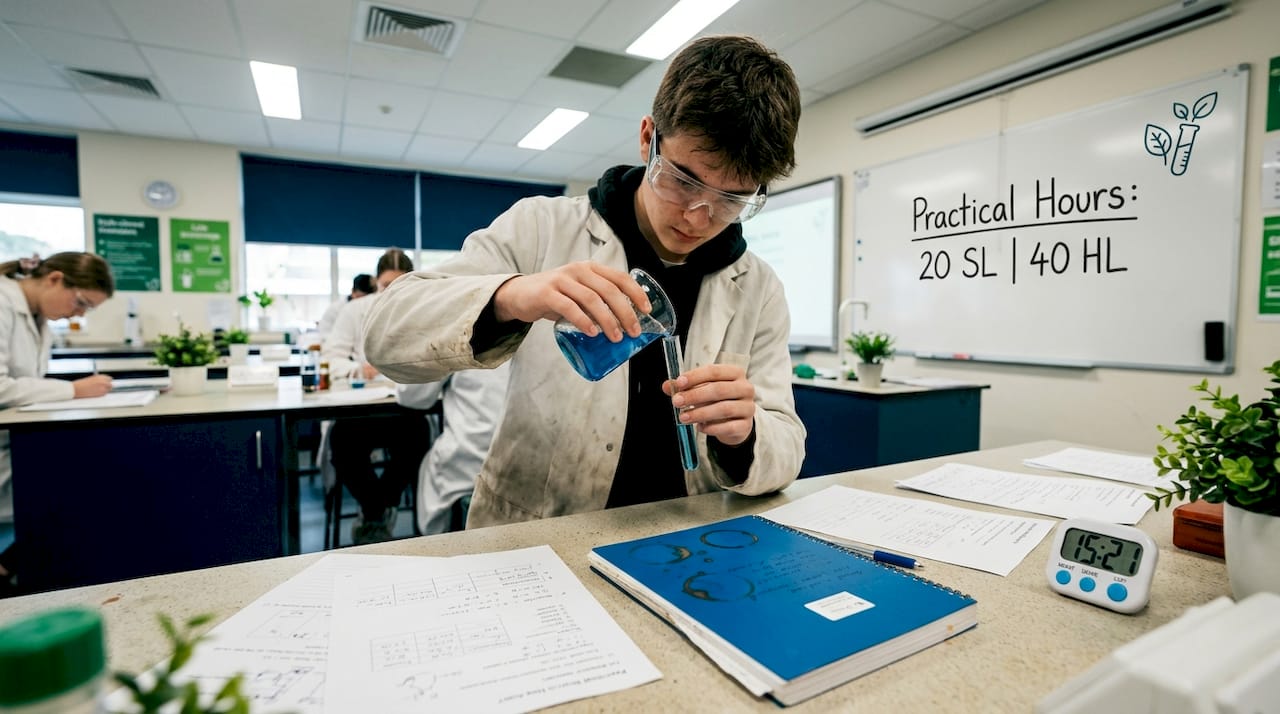
One area students consistently underestimate is the practical component. Practical work includes 20 hours for SL and 40 hours for HL, plus a 10-hour collaborative project and a 10-hour scientific investigation. That’s a significant chunk of your study time that needs to be planned in advance, not squeezed in at the last minute.
Here’s a comparison of planning tools to help you decide what works for your style:
Tool | Best for | Drawbacks |
Digital checklist app (e.g., Notion, Todoist) | Tracking HL extensions, tagging themes | Requires setup time |
Paper planner | Quick daily scheduling | Hard to reorganize |
Spreadsheet | Visual progress tracking across 40 topics | Can become overwhelming |
Hybrid (digital + paper) | Most IB students who need flexibility | Requires discipline |
For resources for the new IB Biology syllabus, look for materials that are explicitly aligned with the first-examination-2026 format. Older resources may cover similar content but miss the new conceptual framing that examiners are specifically testing.
When it comes to structuring lessons and study blocks, consistency beats intensity. Forty-five-minute focused sessions with a ten-minute break outperform three-hour marathons every time, especially when you’re covering dense content like genetics or enzyme kinetics.
Pro Tip: Color-code your notes and flashcards by theme. Use one color per theme consistently across all your materials. When you sit down to review, your brain will start associating colors with conceptual clusters, which speeds up retrieval during exams.
Designing your step-by-step weekly workflow
Once your resources are ready, it’s time to plan your weekly workflow for consistent progress. The goal is to move through the syllabus systematically without leaving any theme untouched for weeks at a time.
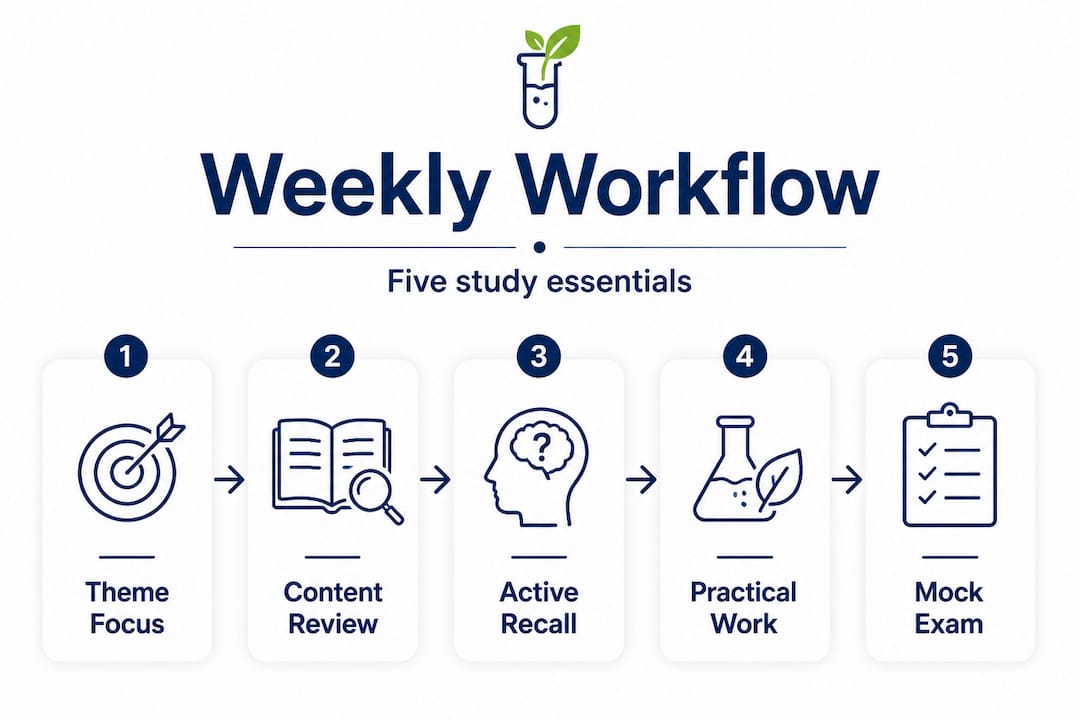
Here’s a proven weekly structure you can adapt:
Monday: Introduce a new topic from your current theme. Read through notes, watch a video explanation, and write a one-paragraph summary in your own words.
Tuesday: Deepen understanding with worked examples and past paper questions on the same topic. Focus on command terms like “explain,” “evaluate,” and “compare.”
Wednesday: Cover the HL extension for that topic if you’re an HL student. These extensions often require more abstract thinking, so give them dedicated time rather than tacking them onto a full session.
Thursday: Active recall session. Close your notes and write down everything you remember from Monday and Tuesday. Use flashcards or a blank page. This is where real learning happens.
Friday: Practical and investigation work. Block this afternoon for lab reports, collaborative project progress, or scientific investigation planning.
Weekend: One session for a mini mock (10 to 15 questions from recent topics) and one session for free review of anything that felt unclear during the week.
The IB DP Biology syllabus specifies that each theme has topics across all four levels of organization and includes a collaborative project and investigation. This means your workflow must account for both content mastery and process skills simultaneously.
For level alignment tips when moving between organizational levels, practice writing short answers that explicitly link the molecular explanation to the organism-level consequence. Examiners reward students who can make these connections clearly and concisely.
Aim to cover two themes per term. This gives you enough time to go deep rather than skimming the surface. In your second year, you’ll revisit all four themes with a focus on exam technique and integration.
For topic-level examples that show how to structure your notes at each level of organization, look at how top-scoring students break down complex topics like evolution and speciation across molecules, cells, organisms, and ecosystems.
Pro Tip: Block Friday afternoons specifically for investigation work. Treat it like a non-negotiable appointment. Students who integrate investigation sessions into their weekly routine consistently submit stronger internal assessments and feel less stressed in the final term.
Troubleshooting common workflow pitfalls
Even well-organized plans meet challenges. Here’s how to keep your workflow on track when things start to slip.
The most common problems and how to fix them:
Falling behind on HL extensions: If you skip HL extensions to save time, you’re gambling with a large portion of your marks. Schedule them immediately after the core topic, not at the end of the unit.
Overlapping topic coverage: The four themes share concepts. Photosynthesis appears in Form and function but connects directly to Interaction and interdependence. Use a concept map to track overlaps and avoid relearning the same material twice.
Insufficient mock exam practice: Many students do their first full mock in the final month. That’s too late. Start doing timed Paper 1 and Paper 2 practice from the end of your first term.
Losing track of the investigation component: The scientific investigation is 10 hours of structured work. Break it into five two-hour sessions spread across the year, not a frantic rush in term three.
Ignoring command terms: “Outline” and “explain” are not the same thing. Build a command term reference sheet and check it every time you write a practice answer.
“There are 40 topics total, with HL extensions marked by *. Practical work includes 20h SL/40h HL, collaborative project 10h, scientific investigation 10h.”
This workload is substantial. Students who try to front-load all their content learning and leave practicals to the end consistently underperform. Your workflow needs to treat practical hours as fixed commitments, not optional extras.
For workflow alignment tips on topics like classification and cladistics that tend to trip students up, focus on understanding the logic of the system rather than memorizing every example. Examiners test application, not recall.
Verifying your workflow: Measuring and adjusting for top performance
Your workflow is only as good as your results. Know when and how to refine your strategy.
The most reliable way to verify your progress is through mock exam scores. After completing each theme, take a 30-minute mini mock covering only that theme’s topics. Score it honestly, then map your errors back to specific topics and levels of organization. This tells you exactly where to spend your next revision block.
Here’s a simple self-assessment tracker you can build into your planner:
Theme | Content coverage (%) | Mock score | Practical hours logged | Action needed |
Unity and diversity | 100% | 78% | 8h | Review cell topics |
Form and function | 85% | 65% | 5h | More HL extension work |
Interaction and interdependence | 70% | 72% | 4h | Complete coverage |
Continuity and change | 60% | 68% | 3h | Increase practical hours |
Key habits for top performers:
End-of-theme self-assessment: Before moving to the next theme, write a one-page summary of everything you know. Then check it against your notes and mark scheme responses.
Track practical hours weekly: Don’t wait until the end of the year to count your hours. Log them every Friday.
Adjust your time allocation monthly: If mock scores show a persistent gap in one theme, shift 20% of your next month’s study time toward it.
Use mark schemes as a learning tool: Every time you miss a mark, read the mark scheme and understand the exact language the examiner expected.
Scientific investigation time forms a core part of your verification and revision process. Students who treat their investigation as a learning exercise rather than a box-ticking task develop stronger analytical skills that transfer directly to Paper 3 performance.
For HL mock exams that are fully aligned with the 2026 syllabus, use resources specifically built for the new format. Generic past papers from pre-2023 syllabuses will not reflect the current exam structure.
Why detailed workflows beat cramming for IB Biology success
With all the practical steps covered, it’s worth reflecting on why this approach outperforms old-school cramming. And the answer is more interesting than most students expect.
Cramming works for short-term recall. If you need to remember a list of facts for 48 hours, intensive repetition is actually effective. The problem is that IB Biology exams don’t test lists. They test your ability to connect ideas across organizational levels, apply concepts to unfamiliar scenarios, and evaluate experimental data in real time. Those skills cannot be built in 48 hours.
Workflow-based study works because it distributes learning over time, which is what cognitive science calls spaced practice. Each time you revisit a topic after a gap, your brain has to reconstruct the memory, and that reconstruction process strengthens the neural pathways. By the time you sit the exam, you’re not trying to recall information. You’re accessing it.
For students targeting medical school in Europe, this distinction matters even more. Medical school admissions in countries like the Czech Republic, Hungary, and Poland are highly competitive, and IB Biology scores carry significant weight. A Grade 7 built on genuine conceptual understanding will also prepare you far better for the entrance exams many of these universities require.
The insights from high-achieving IB alumni who went on to study medicine consistently point to one habit: they treated IB Biology like a marathon training program, not a sprint. They built their fitness gradually, tested themselves regularly, and adjusted their training when something wasn’t working.
The students who struggle most are not the ones with the least ability. They’re the ones who wait too long to start their workflow, skip the verification steps, and rely on familiarity with content as a substitute for actual exam practice. Familiarity feels like knowledge but it falls apart under timed exam conditions.
Pro Tip: Use your workflow as a flexibility tool, not a rigid script. If a topic takes longer than expected, shift your schedule forward by one session rather than skipping the topic. Accountability without rigidity is the mindset that keeps top performers on track through two full years of the Diploma Programme.
Take your IB Biology workflow to the next level
If you’ve worked through this article and feel ready to build a serious, structured approach to your IB Biology preparation, the next step is finding resources that match the exact syllabus structure you’re working with.
At Acebiochem7, every resource is built specifically for the 2026 IB Biology and Chemistry exams by high-achieving IB alumni who know exactly what examiners are looking for. The comprehensive revision course covers all four themes with notes, practice questions, and video solutions aligned to the new syllabus. If you’re an HL student, the HL mock test pack gives you realistic exam practice under timed conditions. And if you’re preparing for both Biology and Chemistry, the Complete Science Revision Pack gives you everything in one place. Build your workflow with the right support behind it.
Frequently asked questions
How is the IB Biology syllabus structured in 2026?
The IB DP Biology syllabus is organized into four themes: Unity and diversity, Form and function, Interaction and interdependence, and Continuity and change, each with two core concepts covering molecules, cells, organisms, and ecosystems. This structure means every topic must be understood at multiple levels of biological organization.
How many practical hours are required for IB Biology SL and HL?
SL students must complete 20 hours of practical work and HL students 40 hours, in addition to a 10-hour collaborative project and a 10-hour scientific investigation. These hours are non-negotiable and must be planned into your workflow from the start of the course.
What is the best way to schedule IB Biology study sessions?
Spread study across all four themes each term, using a weekly structure that includes new content, active recall, HL extension work, and dedicated practical sessions. Regular mini mocks after each theme keep your exam technique sharp throughout the year.
Do I need to complete all HL extension topics for IB Biology?
Yes. HL extensions marked by * are mandatory for HL students and are directly tested in Papers 1 and 2. Skipping them is one of the most common reasons HL students fall short of a Grade 7.
Recommended


Comments