
European Medical Universities: Your IB Application Guide
- acebiochem
- May 5
- 9 min read

Somewhere along the way, a myth took hold among high school students: if you want to study medicine, your only real options are a US pre-med track or a UK medical school. That belief is quietly costing thousands of talented IB students their best shot at a medical career. European medical universities have produced world-class physicians for centuries, and today many of them actively recruit international students, offer programs in English, and charge a fraction of what US or UK schools do. This guide breaks down exactly what these institutions are, what they require, and how you as an IB student can build a winning application.
Table of Contents
Key Takeaways
Point | Details |
Direct entry from high school | You can apply to many European medical schools straight from IB without needing a bachelor’s degree. |
English-taught programs available | Numerous European universities offer full medical degrees in English for international students. |
IB diploma widely accepted | European medical schools generally recognize the IB diploma, but you must meet subject and score criteria. |
Entrance exams common | Expect to prepare for admissions tests and interviews as part of the application process. |
Early preparation is key | Start your applications early and gather all documents to increase your chances of success. |
What defines a European medical university?
European medical universities are higher education institutions across continental Europe that award accredited medical degrees, typically an MD or an equivalent qualification recognized both locally and internationally. What makes them genuinely different from the US or UK model is the entry point. In the United States, you cannot enroll in medical school straight from high school. You first complete a four-year undergraduate degree, then sit the MCAT, then apply to a graduate-level medical program. That path takes a minimum of eight years before you even touch a residency. In Europe, you apply directly after finishing secondary school, and the medical program itself runs for five to six years. You are practicing clinical rotations years earlier.
Many of these universities were founded centuries ago and carry enormous academic prestige within their home countries and across the European Union. The Charles University in Prague, Semmelweis University in Budapest, and Jagiellonian University in Krakow are just a few examples with long histories of medical excellence. What has changed in recent decades is that many of these schools now offer entire programs taught in English, specifically designed to attract non-EU students, including IB graduates from around the world.
Many European medical programs are built from the ground up to accommodate international students, with English-taught tracks, international student offices, and faculty experienced in working with diverse cohorts.
Here is a quick overview of how European medical universities compare to other models:
Feature | European medical university | US medical school | UK medical school |
Entry level | Undergraduate (post high school) | Graduate (post bachelor’s) | Undergraduate (post A-levels or IB) |
Program length | 5 to 6 years | 4 years (plus 4-year undergrad) | 5 to 6 years |
Tuition range | $6,000 to $18,000 per year | $50,000 to $65,000 per year | $25,000 to $45,000 per year |
English-taught options | Yes, widely available | N/A (English native) | Yes |
IB diploma accepted | Yes, most schools | Via undergrad admissions | Yes |
Key features that define European medical universities include:
Accreditation through national ministries of education and often listed in the World Directory of Medical Schools
Degrees recognized for licensing in EU member states and in many non-EU countries
Clinical training integrated from early years, not just the final stretch
A student body that is genuinely international, especially in English-taught programs
Lower cost of living in many host cities compared to London or New York
Types of degrees and languages offered
With a clearer understanding of what European medical universities are, let’s look at the types of degrees and language options you can expect as an IB applicant.
The degree title varies by country, but the underlying qualification is equivalent. In Hungary and the Czech Republic, graduates receive an MD. In Poland and some other countries, the degree is labeled MBBS, mirroring the British system. In Romania and Bulgaria, the degree is often called Doctor of Medicine. Regardless of the title, all of these qualifications can make you eligible to sit licensing exams in multiple countries, including the United States Medical Licensing Examination (USMLE) and the Professional and Linguistic Assessments Board (PLAB) test in the UK, provided you meet additional requirements.
Country | Degree awarded | Program length | English-taught track |
Hungary | MD | 6 years | Yes |
Poland | MBBS / MD | 6 years | Yes |
Czech Republic | MD | 6 years | Yes |
Romania | MD | 6 years | Yes |
Bulgaria | MD | 6 years | Yes |
Slovakia | MD | 6 years | Yes |
Latvia | MD | 6 years | Yes |
English-taught programs worth knowing about include:
Semmelweis University (Budapest) runs a fully English-language MD program with over 4,000 international students enrolled
Medical University of Warsaw offers an English Division that has been running for decades
Carol Davila University of Medicine and Pharmacy in Bucharest has an English-taught track at competitive tuition rates
Medical University of Sofia provides English-medium instruction with lower living costs than Western Europe
For IB students who are not native English speakers, some universities also offer bilingual programs or require proof of English proficiency through IELTS or TOEFL scores. If English is your language of instruction at your IB school, many universities will accept that as sufficient evidence without requiring a separate test. Always verify this directly with each institution.
Admission requirements for IB students
Once you have chosen your degree and teaching language, it is crucial to understand the admissions criteria you will face as an IB student. The good news is that the IB diploma is widely recognized by European medical universities as a rigorous pre-university qualification. The challenge is meeting the specific subject and grade thresholds.
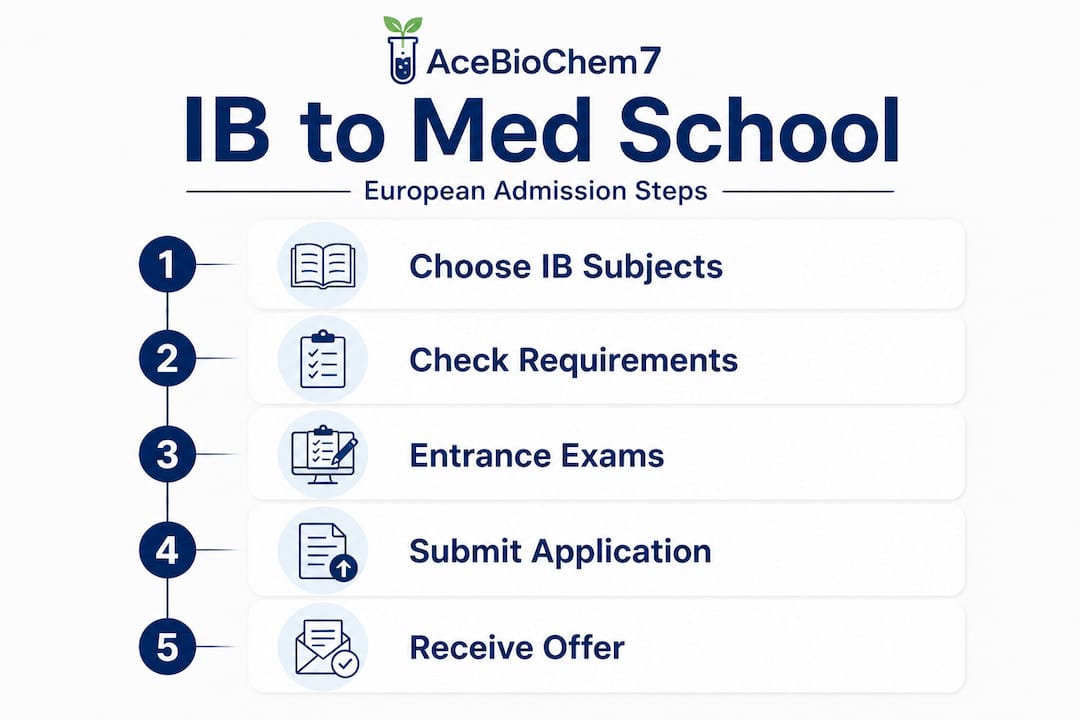
Most European medical universities expect the following from IB applicants:
IB diploma completion with a competitive total score, typically 32 points or above, though top programs may want 36 or higher
Higher Level Biology and Chemistry are almost universally required, often with a minimum grade of 6 or 7 in each subject
Mathematics at Standard Level or Higher Level, depending on the university
English proficiency evidence if English is not your primary language of instruction
Entrance examination results from university-specific tests or internationally recognized exams such as the IMAT (International Medical Admissions Test used in Italy) or the BMAT
Personal statement or motivation letter explaining your reasons for choosing medicine and that specific university
Letters of recommendation from science teachers or school counselors
Interview performance, either in person or via video call, at schools that include this stage
The entrance exam requirement deserves special attention. Countries like Italy use the IMAT, a standardized test covering biology, chemistry, physics, mathematics, and general knowledge. Hungary and Poland have their own university-specific entrance exams. Preparing for these exams is not optional. Students who skip dedicated exam prep consistently underperform compared to those who treat the entrance test as seriously as the IB exams themselves.

Pro Tip: Check whether your target university accepts predicted IB grades for conditional offers. Many schools will give you a conditional acceptance based on your predicted scores before your final results arrive in July. This means your teachers’ predicted grades carry real weight, so make sure you are communicating clearly with them and that your internal assessments reflect your true ability.
Some universities also consider extracurricular activities, volunteering in healthcare settings, or shadowing experiences. These are not always required, but they strengthen your motivation letter significantly and demonstrate genuine commitment to a medical career.
Application strategies and timelines
With admissions requirements laid out, the next step is learning how to position yourself and when to begin. Timing is everything in European medical university applications, and many students start too late.
Most universities open their applications between October and January for programs beginning the following September. Some of the most competitive English-taught programs, particularly in Hungary and Poland, fill their international spots quickly. Aiming to have your application materials ready by November of your final IB year is a realistic and strategic target.
Here is what you need to gather before submitting:
Official IB transcripts or predicted grade letters from your school
A motivation letter tailored to each university (generic letters are easy to spot and rarely succeed)
Two or three letters of recommendation, ideally from your Biology and Chemistry teachers
Passport copy and any required visa documentation
Proof of English proficiency if required
Entrance exam registration confirmation and, later, your score report
Any healthcare volunteering or shadowing documentation
Pro Tip: Your IB Internal Assessments and Extended Essay can be powerful material for your personal statement. If your Biology IA investigated a topic related to human physiology or disease, mention it. If your Extended Essay explored a medical or biochemical question, reference it. Admissions officers reading hundreds of applications notice students who connect their academic work to genuine curiosity about medicine.
Common application pitfalls to avoid:
Applying to only one or two schools. European medical admissions are competitive and somewhat unpredictable. Apply to at least four to six programs across different countries to give yourself real options.
Underestimating the entrance exam. Many students assume their strong IB scores are enough. They are not. The entrance exam is a separate hurdle that requires dedicated preparation.
Sending a generic motivation letter. Each letter should reference the specific university, its program structure, and why it fits your goals.
Missing document deadlines. Some universities have rolling admissions and close spots before the official deadline. Submit early.
Ignoring visa requirements. Non-EU students need to plan for student visa applications, which can take weeks or months depending on your country of origin.
Our take: Why thinking globally pays off for future doctors
Here is something we have noticed working with IB students over the years: the students who limit their medical school search to one country are often the ones who end up most stressed and most disappointed. The students who cast a wider net, who are genuinely curious about studying in Prague or Budapest or Warsaw, tend to find programs that fit them far better than anything they originally imagined.
There is a deeper point here beyond just increasing your odds of acceptance. Medical education in Europe exposes you to healthcare systems, patient populations, and clinical challenges that are genuinely different from what you would encounter in a single-country training environment. That kind of exposure builds a flexibility and adaptability that modern medicine desperately needs. The global shortage of physicians means that doctors who can work across systems, understand different protocols, and communicate with diverse patient groups will be in extraordinary demand throughout their careers.
We also want to push back on the rankings obsession that grips many IB students. A school ranked 200th globally but with excellent clinical placements, supportive faculty, and a strong alumni network in your target specialty may serve your career far better than a top-20 school where you are one of 300 students fighting for the same research spot. Think about where you want to practice, what kind of doctor you want to become, and which program’s structure actually matches that vision. European medical universities, with their early clinical integration and international student communities, often align better with those goals than students initially expect.
Get tailored support for your IB science journey
With a global medical education in mind, the right preparation in IB science can make all the difference in your application. Your Biology and Chemistry grades are not just numbers on a transcript; they are the first filter every European medical university applies when reviewing IB applicants.

At AceBioChem7, we build our resources specifically for IB students aiming at Grade 7 in science. Our IBDP Biology courses cover every topic on the current syllabus with exam-focused notes and video solutions created by high-achieving IB alumni who know exactly what examiners look for. If you need structured revision support, our Biology revision packs are aligned with 2026 exams and include practice questions that mirror real paper difficulty. For students who need to sharpen their Chemistry scores, our IBDP Chemistry support gives you the same exam-targeted approach. Strong science grades open the door to European medical schools. We help you get there.
Frequently asked questions
Are European medical university degrees valid worldwide?
Most European medical university degrees are internationally recognized, but you must verify the specific licensing requirements of the country where you plan to practice, as each nation sets its own rules.
Which European countries offer English-taught medical programs?
Hungary, Poland, Romania, the Czech Republic, Bulgaria, Slovakia, and Latvia all offer medical programs taught entirely or primarily in English, with established international student tracks.
Does the IB diploma meet admission requirements for European medical schools?
Yes, the vast majority of European medical universities accept the IB diploma, provided you meet their specific subject requirements, typically Higher Level Biology and Chemistry with strong grades.
Is an entrance exam required for all European medical universities?
Not universally, but many European medical universities require a university-specific or standardized entrance exam, so you should research each school’s requirements individually and prepare accordingly.
Recommended


Comments