
IB Syllabus Explained: Ace Your Biology and Chemistry Exams
- Adam Nahar

- May 3
- 9 min read
Updated: May 4

Rote memorization got students through the old IB science exams. That approach no longer works. The 2023+ syllabi now reward conceptual understanding, scientific inquiry, and the ability to connect ideas across topics rather than simply recall facts. If you’re aiming for a Grade 7 in IB Biology or Chemistry, and you have your sights set on a medical degree in Europe, understanding exactly how these syllabi are built is the single most important strategic move you can make before you open a textbook.
Table of Contents
Key Takeaways
Point | Details |
Conceptual mastery is key | The new IB syllabi focus on interconnected themes and critical thinking, not just memorization. |
Data and inquiry matter most | Papers 1 and 2 test your ability to analyze data and apply skills, which is crucial for a Grade 7. |
Practical skills are essential | Success now depends on handling experiments, understanding limitations, and scientific inquiry. |
Prior syllabi advice may be outdated | The removal of options and Paper 3 means updated strategies are needed for exam prep. |
Grade 7 opens med school doors | A top score in HL Bio and Chem is vital for European medical program admissions. |
How the IB Biology and Chemistry syllabi are structured
Now that you know why a strategic approach is essential, let’s break down how each IB science syllabus is actually structured.
The first thing to understand is that both subjects have moved away from a traditional chapter-by-chapter format. Instead, they are organized around big ideas that force you to think across topics rather than within them. This is a deliberate design choice, and it directly shapes how exam questions are written.
IB Biology is built around four broad themes, each containing two guiding concepts. According to the IB Biology syllabus overview, these themes are explored across four levels of biological organization: molecular, cellular, organism, and ecosystem. The four themes are:
Unity and diversity
Form and function
Interaction and interdependence
Continuity and change
Each theme connects content that might otherwise feel isolated. For example, “form and function” applies equally to enzyme active sites at the molecular level and to leaf structure at the organism level. The syllabus contains 40 topics and subtopics, giving you a clear map of everything you need to know.
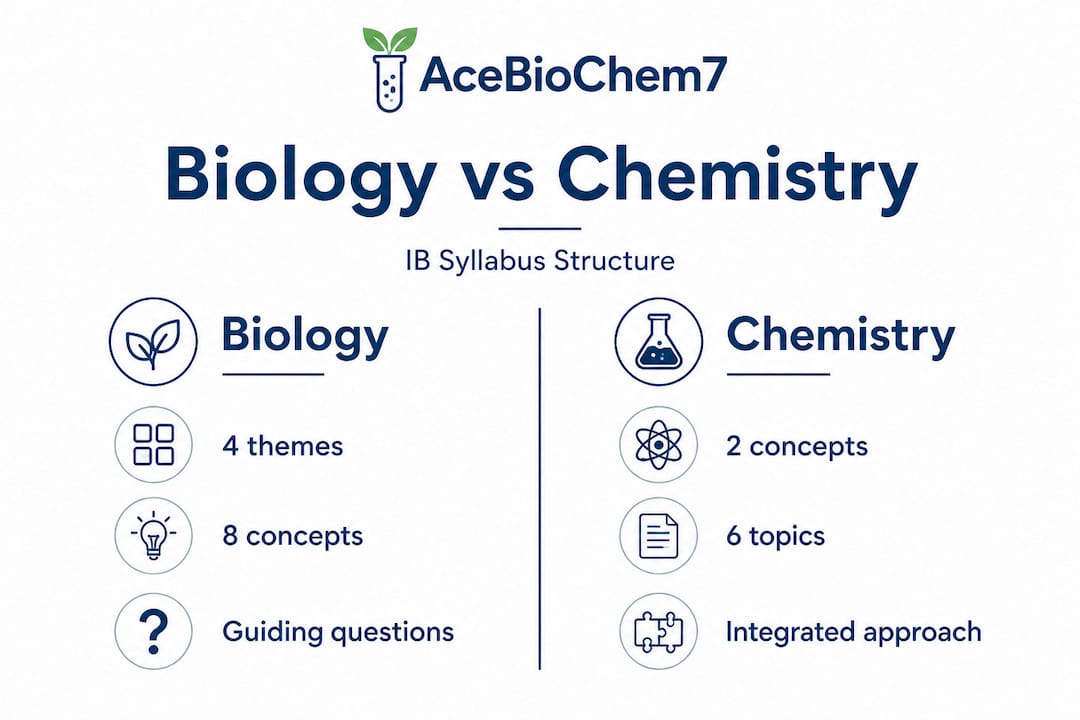
IB Chemistry takes a similarly integrated approach. The IB Chemistry syllabus is structured around two overarching concepts, Structure and Reactivity, subdivided into six main topic areas. These cover atomic theory, bonding, energetics, kinetics, equilibrium, and redox and organic chemistry. You can explore the full IB Chemistry overview to see how these six areas build on each other progressively.
Here’s a side-by-side comparison to make the structural differences clear:
Feature | IB Biology | IB Chemistry |
Organizing framework | 4 themes, 8 concepts | 2 concepts (Structure, Reactivity) |
Main topic areas | 40 topics/subtopics | 6 main areas |
SL teaching hours | 150 hours | 110 hours |
HL teaching hours | 240 hours | 180 hours |
Levels of analysis | Molecular to ecosystem | Atomic to industrial scale |
Key skill emphasis | Data analysis, inquiry | Calculations, mechanisms |
One critical point: both syllabi are built around guiding questions at the start of each topic. These are not decorative. They tell you exactly what kind of thinking the IB expects you to demonstrate. When you study the thematic organization of biology, you’ll notice that guiding questions often appear almost verbatim in Paper 2 extended-response questions. Treat them as a preview of the exam.
Pro Tip: For every topic you study, write a one-sentence answer to the guiding question before you start and again after you finish. The difference between those two answers is exactly what you learned and exactly what the examiner wants to see.
Assessment breakdown: What you need to master for a Grade 7
With the core structure in mind, let’s see what the actual assessments look like and which parts will make or break your Grade 7 aspirations.
Knowing the content is necessary but not sufficient. You also need to understand how that content is tested, because the same knowledge can earn a 5 or a 7 depending on how you apply it under exam conditions.
Paper 1 consists of data-based questions and multiple-choice items. These questions rarely ask you to recall a definition. Instead, they present novel graphs, experimental setups, or datasets and ask you to interpret, calculate, or evaluate. Students who only memorize struggle here because the data is always unfamiliar.
Paper 2 combines structured short-answer questions with extended-response questions. This is where command terms matter enormously. “Explain” requires a mechanism. “Evaluate” requires a judgment with evidence for and against. “Deduce” requires logical reasoning from given data. Misreading a command term can cost you two to four marks per question.
The Internal Assessment (IA) is worth over 20% of your final grade. It is also the component where the gap between a 6 and a 7 most often appears. According to Grade 7 strategies for IB sciences, top students focus 80% of their effort on Papers 1 and 2, but the IA is what frequently pushes a borderline student over the line. A strong IA requires a testable and focused research question, proper propagation of uncertainties, and a specific, evidence-based evaluation that identifies real limitations rather than generic ones.
Here’s how the assessment weighting breaks down for HL students:
Component | Weighting | Key skill tested |
Paper 1 | 20% | Data interpretation, MCQ reasoning |
Paper 2 | 40% | Structured response, extended writing |
Paper 3 | 20% | Practical skills, data analysis |
Internal Assessment | 20% | Experimental design, evaluation |
To reach Grade 7, you realistically need to be scoring in the 80 to 85% range on practice papers consistently. Only around 15% of HL candidates achieve Grade 7, which means you need to be deliberate about where you spend your revision time. Use targeted revision plans that prioritize high-yield topics and Paper 2 extended-response practice above everything else.
Here’s a prioritized approach for Grade 7 preparation:
Master all command terms and practice applying them in timed conditions
Complete at least three full past papers under exam conditions before your mock exams
Review every mark scheme answer critically, not just to check if you got it right, but to understand the exact language the IB rewards
Dedicate two full revision sessions specifically to IA evaluation, focusing on uncertainty propagation and specific improvements
Practice linking questions that connect two or more topics, because these appear in Paper 2 and are where top marks are won
Pro Tip: When writing extended-response answers, always start with the mechanism or process at the molecular or atomic level before scaling up. Examiners consistently award more marks to answers that demonstrate depth of understanding at the smallest scale first.
Inquiry skills and practicals: What’s new and why it matters
Understanding assessment is only half the battle. Mastering inquiry and practical skills is just as critical in the new syllabus.
The new IB science syllabi place practical methodologies at the center of the learning experience. This is not just about doing experiments in the lab. It means you need to think like a scientist when you encounter any unfamiliar situation, whether that’s in your IA, in a Paper 1 data question, or in a Paper 2 scenario.
There are several key shifts in how practical skills are now assessed and developed:
Experimental design is tested directly. You may be asked to design a controlled experiment from scratch, including identifying variables, selecting appropriate methods, and justifying your choices.
Data analysis goes beyond reading a graph. You need to calculate percentage uncertainties, identify anomalies, and explain what those anomalies mean for the validity of a conclusion.
Group IA rules are specific: you can share data with classmates only if each student has a unique independent variable or dependent variable. Sharing identical datasets is academic misconduct.
Nature of Science (NOS) is woven throughout both syllabi. This theme asks you to reflect on how scientific knowledge is built, revised, and limited. NOS questions appear in both papers and reward students who can think critically about the scientific process itself.
“The most common mistake in IB science practicals is writing vague limitations like ‘human error’ or ‘equipment limitations.’ A strong evaluation names the specific source of error, quantifies its likely impact, and suggests a concrete improvement.”
For Biology specifically, cellular investigations form a core part of the practical program. Understanding how to set up and analyze cellular experiments, from osmosis investigations to enzyme kinetics, gives you both IA topic ideas and direct preparation for data-based exam questions.
The NOS theme is particularly valuable for students heading into medicine. Medical schools in Europe want students who understand that science is a process of ongoing revision, not a collection of fixed facts. Demonstrating NOS thinking in your IA evaluation and in Paper 2 extended responses signals exactly the kind of scientific maturity that top universities are looking for.
What’s changed: Comparing the old and new IB science syllabi
Many students and tutors still use outdated strategies, so here’s how the current syllabus is truly different and what that means for your study plan.
If you’ve been using revision materials from before 2023, or if your tutor trained on the old syllabus, you need to know what has actually changed. Using outdated strategies in the current syllabus is one of the most common reasons capable students underperform.
According to IB Biology syllabus updates, the new syllabus has approximately 5% less content overall, but the reduction is not evenly distributed. The bigger changes are structural:
Feature | Old syllabus | New syllabus |
Paper 3 | Content-heavy option topics | Practical and data skills focus |
Option topics | Four standalone options | Removed entirely |
Content organization | Topic-by-topic, largely linear | Thematic, networked understanding |
IA emphasis | Moderate | Significantly increased |
Critical thinking demand | Moderate | High, especially in Paper 2 |
The removal of option topics is significant. Previously, students could specialize in one area and avoid others. Now, everything is integrated. You cannot afford gaps in your understanding because exam questions routinely draw connections across multiple themes. For example, a question might ask you to connect enzyme inhibition (molecular level) to population dynamics (ecosystem level) within a single extended response.
The IB syllabus updates in Chemistry follow the same logic. Enthalpy changes, for instance, are no longer just a standalone topic. They are connected to bond energetics, reaction feasibility, and industrial applications all within the same assessment context.
Here’s what this means practically: a leaner syllabus does not mean easier exams. It means the exams go deeper on fewer topics. Every topic you study, you need to understand thoroughly and be able to apply in unfamiliar contexts.
Our perspective: What most IB students miss about the new syllabus
We’ve worked with hundreds of IB students aiming for Grade 7 and medical school admissions in Europe, and the pattern is consistent. The students who struggle are not the ones who lack knowledge. They are the ones who have knowledge but cannot connect it.
The new syllabus was specifically designed to expose this gap. When a Paper 2 question asks you to evaluate a novel dataset from a study you’ve never seen, memorized facts are almost useless. What saves you is the habit of asking “why does this make sense mechanistically?” every time you encounter a new concept during your studies.
The students who consistently score in the Grade 7 range practice interpreting new data every single week. They do not just review content. They sit with unfamiliar graphs, write out explanations, check the mark scheme, and then ask themselves why the examiner’s answer is better than theirs. That reflective loop is the real skill the new syllabus rewards.
Another thing most students miss: the real IA examples that earn top marks share a specific quality. They are not impressive because of elaborate equipment or unusual topics. They earn top marks because the evaluation is ruthlessly specific. Every limitation is quantified. Every improvement is practical and directly addresses the identified limitation. Generic evaluations, no matter how well written, do not score in the top band.
Our honest advice: stop treating IB Biology and Chemistry as two separate subjects to memorize. Start treating them as two lenses for the same underlying scientific thinking skills. Students who make that mental shift consistently outperform those who don’t, regardless of raw intelligence or prior knowledge.
Next steps: Maximize your IB science success with AceBioChem7
Ready to put this understanding into action? Here’s how AceBioChem7 can guide your path to a Grade 7 in IB Biology and Chemistry.
Everything on AceBioChem7 is built around the current IB syllabus and created by alumni who achieved Grade 7 themselves. The IB Biology revision course walks you through every theme with exam-focused notes, worked examples, and practice questions that mirror the style and difficulty of real Paper 1 and Paper 2 questions.
For Chemistry, the IB Chemistry support resources cover Structure and Reactivity with a focus on the calculation-heavy and mechanism-based questions that determine your final grade. Mock test packs are aligned to the 2026 exam format, so you practice exactly what you’ll face. Check the plans and pricing to find the right level of support for your timeline and goals. Whether you have six months or six weeks, there is a structured path to Grade 7 waiting for you.
Frequently asked questions
What are the main themes of the IB Biology syllabus?
The IB Biology syllabus centers on four themes: unity and diversity, form and function, interaction and interdependence, and continuity and change, each explored across multiple levels of biological organization from molecular to ecosystem.
How is the IB Chemistry syllabus organized?
The Chemistry syllabus is built around Structure and Reactivity, divided into six main topic areas covering everything from atomic models to organic reaction mechanisms.
What’s the biggest change in the 2023 IB science syllabi?
The new syllabus removes Paper 3 option topics and places much greater emphasis on conceptual links, inquiry skills, and practical application tasks across all remaining content areas.
How important is the IA for achieving a Grade 7?
The IA often separates a 6 from a 7; a clear testable research question, proper uncertainty propagation, and specific evidence-based evaluation are the three elements that consistently earn top IA scores.
Do I need both IB Biology and Chemistry HL for medical studies in Europe?
Yes, most European medical universities require HL Biology and Chemistry as prerequisites, and a Grade 7 in both subjects demonstrates the level of scientific mastery that competitive programs expect from applicants.
Recommended


Comments